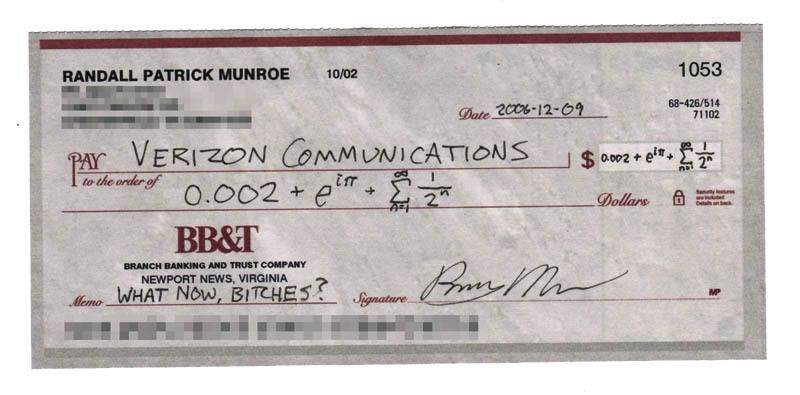
I'm old.
Monday, April 30, 2007

Friday, March 16, 2007
5 Common Mistakes Made by Startups
OK, so I have been layed off twice by start up companies. One when it was only 1 year old and the other when it was about 3-4 years old.
The first one was obvious to me, they spent too much money way to quickly. They basically didn't save money for a rainy day. I can't believe the president didn't know that not every year of incoming money was going to be the same. They basically tried to grow way to fast, in a short amount of time. Heck, they had private stock options within 3 months of starting up. This was a small business trying to act big before their time.
The second business basically stayed to small for too long. They are spread out across America mostly on the west coast and mountain areas. They also took up business that they should of just declined on. They basically ended up in a situation of having doing business with companies that just took up too much of their time for not much money, or any at all.
So here are the top 5 mistakes of start ups from http://startupspark.com/the-5-most-common-mistakes-made-by-startups/
- Staying in Stealth Mode Too Long. New start ups seem quite fond of stealth mode
(or its newer cousin “ninja mode”), when they’re hiding under the radar but
still hyping just enough to try and pique interest. But stay in stealth mode too
long and you run the risk of disappearing off the radar. Never mind the fact
that you can’t sell your new product or service while in stealth mode and therefore can’t generate any revenue. There are plenty of reasons why start ups launch too
slowly; really you need to force yourself to launch and get past all the
excuses. - Not Focusing on the User.
Who are you building your new product for? Who is the precise target? Many start ups can give a generic answer to that question, but very few of them are really honed in on the specific wants of their “perfect user.” This is a combination of too little research and too much enthusiasm for what they think is “the next killer idea.” This mistake is compounded if you’re building something that you wouldn’t use yourself. Building something you would use makes things easier - you’re the target user. Otherwise you need to take a much more pragmatic approach. As well, many start ups take the approach of “being everything to everyone.” That strategy never works. You end up being nothing to anyone. - Trying To Do Everything.
If a task isn’t core to your business try and outsource it. Entrepreneurs are extremely fond of saying they wear many hats (which is true!) but there’s a limit to what’s reasonable in the hat-wearing department. Lots of things can be outsourced, and although you’ll be paying someone else to do the work, you’ll be freeing up precious time of your own. That time will be infinitely more valuable than the money you spend. - Not Having Enough
Infrastructure. Many start ups don’t have the proper tools in place to start
their business. Primarily, money and time. It’s getting cheaper and cheaper to
start companies nowadays but it’s never free. Lots of people start companies
without realizing how much money it’s actually going to take. When they clue in,
and decide they don’t have the money to invest (or they’re not willing to part
with it), they’re in trouble. Start ups face similar challenges with time.
People often start companies while working full-time jobs. It’s doable but damn
hard. And as soon as the start up gets a bit rocky or other interests come into
play, the start up company gets shelved or delayed. Paul Graham comments on this
beautifully in The 18 Mistakes That Kill Start ups. His theory is that people get into start ups half-heartily and that’s what kills them. I think that’s part of the answer.
The other side of that coin is that people truly do care and believe in what
they’re doing, but they don’t have the infrastructure and bandwidth in place to
make it happen. Infrastructure issues are also related to a start up’s lack of
connections and resources to find good vendors, good hires, mentors and people
to rely on. A couple guys in a garage may have a great idea and tons of talent
but when they need help securing a loan or handling a business-related task they
may not have the network or foundation in place to support them. - Forgetting About Branding, Marketing and Sales. I know there are examples of companies succeeding with a “build it and they will come” approach. Some people argue if you build something people want they’ll find it and plunk down their hard-earned money. It happens. But more often than not you need to develop real, actionable and savvy branding, marketing and sales strategies. You might have a great product and the wrong message. Or a killer software application that no one
knows about. It’s rare to have a start up where the founders (or one of them) has
real experience in branding, marketing and sales. The result is either all the
founders do it (and often poorly) or they all pass the buck.
You can take a “build it and they will come” approach and hope for the world to pick up your scent and fall in love with you, or you can figure out how you’ll get the
message out, what that message will be and how you’ll generate leads. Go with
the latter.
So company 1's mistakes: 3 and 4
Company 2's mistakes: 1, 2, and 3
Even though company 2 had more mistakes, I felt they had a better chance of success.
Tuesday, January 16, 2007
Hack: Wii Backups
http://wii.ps2-scene.org/
So you can back up your wii games now, but it takes 50+ hours to do so. LOL
Monday, January 01, 2007

Tuesday, December 12, 2006

Monday, December 11, 2006
Interesting: Winter Camping
http://www.clubtread.com/articledetail.asp?ID=49
sound fun, I wouldn't mind doing this once.

Myer-Brigs Test: INTP
Well, I'm still a INTP, good to know.
INTP - Physicists, chemists, biologists, photographers, strategic planners, mathematicians, university professors, computer programmers, computer animators, technical writers, engineers, lawyers, forensic researchers, writers, artists, psychologists, social scientists, systems analysts, researchers, surveyors. Highly analytical, they can discover connections between two seemingly unrelated things, and work best when allowed to use their imagination and critical thinking.
INTJ- 2.1% of the population. :)
- Most important feature of an ideal job: creativity and originality.
- In national sample, lowest in reporting stress associated with "School" and "Caring for aging parents."
- In national sample, lowest in coping with stress by "Watching TV."
- In national sample, ranked highest in saying "No" to belief in a higher spiritual power.
- In national sample "Leisure Activities," overrepresented in "Taking classes, going to school," "Appreciating art," "Playing with computers or video games," and "Working out/exercising"; underrepresented in "Watching TV 3 or more hours per day."
- Academic subjects preferred: science.
- Highest GPA among college persisters.
- 1 of 3 highest types in liking work environment characteristic "Variety of tasks" as well as highly favoring "Clear structure" and "Independence & achievement"; lowest of all types in liking work environments characterized by "Making the job as simple as possible."
- In national sample, among types with highest income; dissatisfied with "Future work opportunities," "Promotions," and "Job security" in their jobs.
- Highest rank on coping resources used was spiritual/philosophical - ranked 3rd out of the 16 types.
- Among the 3 male types overrepresented among substance abusers.
It is in their abilities that Masterminds differ from the other Rationals, while in most of
their attitudes they are just like the others. However there is one attitude
that sets them apart from other Rationals: they tend to be much more
self-confident than the rest, having, for obscure reasons, developed a very
strong will. They are rather rare, comprising no more than, say, one percent of
the population. Being very judicious, decisions come naturally to them; indeed,
they can hardly rest until they have things settled, decided, and set. They are
the people who are able to formulate coherent and comprehensive contingency
plans, hence contingency organizers or "entailers."
Masterminds will adopt
ideas only if they are useful, which is to say if they work efficiently toward
accomplishing the Mastermind's well-defined goals. Natural leaders, Masterminds
are not at all eager to take command of projects or groups, preferring to stay
in the background until others demonstrate their inability to lead. Once in
charge, however, Masterminds are the supreme pragmatists, seeing reality as a
crucible for refining their strategies for goal-directed action. In a sense,
Masterminds approach reality as they would a giant chess board, always seeking
strategies that have a high payoff, and always devising contingency plans in
case of error or adversity. To the Mastermind, organizational structure and
operational procedures are never arbitrary, never set in concrete, but are quite
malleable and can be changed, improved, streamlined. In their drive for
efficient action, Masterminds are the most open-minded of all the types. No idea
is too far-fetched to be entertained-if it is useful. Masterminds are natural
brainstormers, always open to new concepts and, in fact, aggressively seeking
them. They are also alert to the consequences of applying new ideas or
positions. Theories which cannot be made to work are quickly discarded by the
Masterminds. On the other hand, Masterminds can be quite ruthless in
implementing effective ideas, seldom counting personal cost in terms of time and
energy.
My results:
http://www.eggheadcafe.com/articles/mb/mbrespond.asp
http://en.wikipedia.org/wiki/INTJ
Take your own test: http://www.eggheadcafe.com/articles/mb/default.asp
Thursday, December 07, 2006
Saturday, November 25, 2006
Sunday, November 19, 2006
Interesting: My celebrity look-a-likes
Fabio Cannavaro - Some spanish soccer player http://en.wikipedia.org/wiki/Fabio_Cannavaro
Jason Biggs - http://en.wikipedia.org/wiki/Jason_Biggs
Boris Karloff - http://en.wikipedia.org/wiki/Boris_Karloff
Eugene O'Neill - http://en.wikipedia.org/wiki/Eugene_O'Neill
Steve Harris - http://en.wikipedia.org/wiki/Steve_Harris_(musician)

Subscribe to:
Posts (Atom)